
Nano Banana 2 vs Pro vs Original: Which Model Should You Use?
Honest comparison of all three Nano Banana models — speed, resolution, credits, and exclusive features. Includes a cost breakdown and decision framework for every use case.
Google’s Nano Banana family now has three distinct models — Nano Banana (original), Nano Banana 2, and Nano Banana Pro — and choosing between them is not as straightforward as “new is better.” Each model makes deliberate trade-offs across speed, cost, resolution, and creative capabilities. If you are deciding which model to use for your next project, this guide gives you the honest breakdown.
We tested all three models on Banana AI, cross-referenced hands-on reviews from early users, and identified where each model genuinely excels versus where the marketing copy oversells the result.
Quick Comparison: All Three Models at a Glance
| Feature | Nano Banana | Nano Banana 2 | Nano Banana Pro |
|---|---|---|---|
| Underlying Model | Gemini 2.5 Flash | Gemini 3.1 Flash Image | Gemini 3 Pro |
| Max Resolution | 1K | 4K | 4K |
| Aspect Ratios | 10 standard | 14 (incl. ultra-wide 8:1, 1:8, 4:1, 1:4) | 10 standard |
| Image Search | No | Yes | No (text-only Google Search) |
| Text Rendering | Good | Very good | Very good |
| Aesthetic Quality | Standard | Good | Best |
| Thinking Mode | No | No | Yes |
| Speed | Fastest (2-5s) | Fast (4-6s) | Slower (includes thinking) |
| Credits on Banana AI (1K/2K) | 5 credits | 7 credits | 10 credits |
| Credits on Banana AI (4K) | N/A | 14 credits | 20 credits |
| API Cost (4K) | N/A | ~$0.15 | ~$0.30 |
| Character Consistency | Basic | 5 faces / 14 objects | 5 faces / 14 objects |
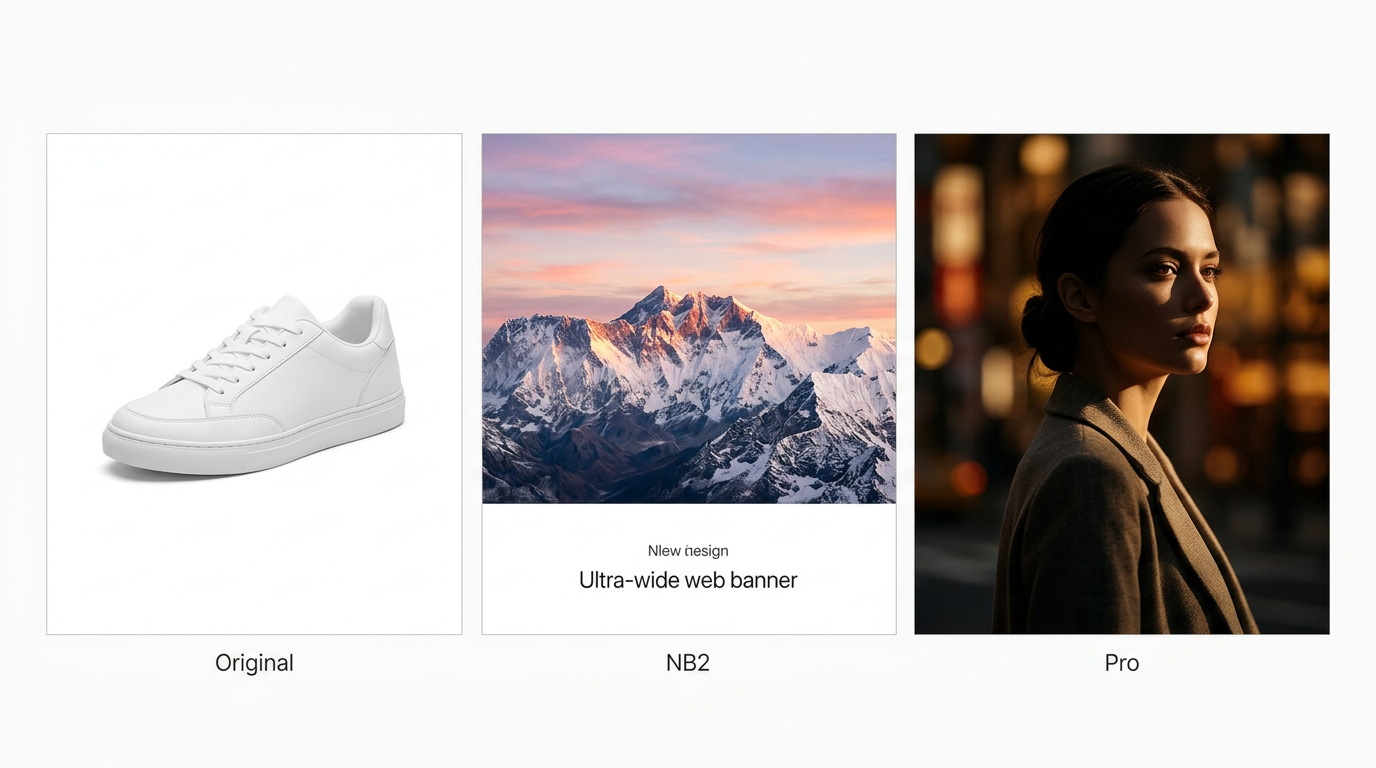
Before diving into each model, the most important thing to understand is this: Nano Banana 2 is not a quality upgrade over Nano Banana Pro. In head-to-head tests, Pro maintains the lead on raw aesthetic quality — and in some scenarios (particularly mixing different visual styles in one scene), NB2 produces weaker results. What NB2 offers instead is a different set of trade-offs: lower cost, exclusive capabilities, and more flexible compositions.
Nano Banana (Original): When Speed Wins
The original Nano Banana runs on Gemini 2.5 Flash and is the fastest model in the lineup. At 2-5 seconds per generation, it is noticeably quicker than NB2 or Pro, and at 5 credits per image it is the cheapest option on Banana AI by a meaningful margin.
What the original Nano Banana is genuinely good at:
- Quick concept exploration — when you need to test an idea fast before committing to a final model, the original Nano Banana gives you usable output in seconds. You can iterate through a dozen variations in the time NB Pro takes to generate one image with its thinking mode.
- High-volume drafting — for e-commerce sellers who need to produce rough concept images across a large SKU catalog before selecting which ones to develop further, 5 credits per image lets you cover a lot of ground on even a modest credit budget.
- Simple social media content — straightforward product photos, event announcement graphics, or basic illustrations that do not require 4K resolution or sophisticated aesthetic composition.
- Budget-first use cases — if you are on the free tier testing the platform, or working within tight monthly credit limits, the original Nano Banana stretches your allocation furthest.
The real limitations: The original Nano Banana tops out at 1K resolution. For anything requiring print-quality output, large-format hero images, or detailed commercial use, that ceiling matters. It also lacks the character consistency features and Image Search capability that NB2 introduced.
The original Nano Banana is best understood as a drafting and prototyping tool — not the one you would use for final output in most professional contexts.
Nano Banana 2: When Cost and Capability Both Matter
Nano Banana 2 launched on February 26, 2026, built on Gemini 3.1 Flash Image. It is the most distinctive model in the lineup precisely because it does not try to be the quality leader — it introduces exclusive capabilities that neither of the other models have, at a price point that makes sustained professional use practical.
NB2-exclusive capabilities that Pro does not have:
Ultra-wide aspect ratios. NB2 supports 14 aspect ratios, including four that are unavailable in any other Nano Banana model:
- 8:1 and 1:8 — for web banners, scrolling panoramas, and infographic strips
- 4:1 and 1:4 — for website headers, vertical stories, and timeline graphics
For a social media manager running a brand account with multiple banner formats, or a web designer who needs a native 8:1 hero image rather than a cropped 16:9, these ratios are not a minor convenience — they are workflow-defining. An 8:1 panorama generated natively looks fundamentally different from a standard-ratio image cropped to fit.
Image Search tool. When NB2 generates images that reference real locations, landmarks, or recognizable objects, it can query Google Image Search to pull visual references during generation. Nano Banana Pro has access to Google Search (text only), but cannot pull visual references. In practice, this tends to produce more accurate results for scenes set in real places — a realistic view of Victoria Harbour, a recognizable city skyline, a historically accurate landmark context.
~50% lower API cost. For developers using the Gemini API directly, a 4K NB2 image costs approximately $0.15 — roughly half the cost of a Nano Banana Pro generation at the same resolution. At scale, this difference compounds quickly: a marketing team generating 500 images per month saves around $75 per month switching from Pro to NB2 for suitable use cases.
Higher free-tier volume. Google offers 100 NB2 images per 24 hours to non-subscribers — no credit card or account required. That is enough to run a real evaluation of the model before committing to a paid plan on any platform.
Where NB2 excels on Banana AI:
- Marketing teams generating high volumes of blog illustrations, social media images, and banner ads — the 7-credit cost at 1K/2K resolution keeps monthly spend predictable
- Multilingual poster creation — NB2’s text rendering stability across English, Chinese, Japanese, and Korean makes it practical for global marketing materials
- Web design work — the ultra-wide ratios mean you can generate native 8:1 headers rather than repurposing standard images
- Any workflow requiring character consistency — up to 5 distinct faces and 14 objects maintained within a single generation
Where NB2 falls short: Raw aesthetic quality. In head-to-head comparisons, Nano Banana Pro’s thinking mode — which analyzes composition and lighting before generating — produces images with stronger composition and more deliberate light-to-shadow relationships. For cross-dimensional style fusion (mixing 2D illustration, 3D rendering, and sketched elements in one scene), NB2 produces less convincing results than Pro: the style blending looks stiffer, and edges where different visual styles meet are more visibly artificial.
Chinese font rendering in NB2 also defaults to a uniform font style when no reference image is provided, which limits typographic flexibility for Chinese-language designs compared to English layouts.
For a detailed look at NB2’s full capabilities, see our Nano Banana 2 features review.

Nano Banana Pro: When Aesthetic Quality Is the Priority
Nano Banana Pro runs on Gemini 3 Pro and includes a thinking mode that is not available in either NB2 or the original Nano Banana. Before generating, Pro analyzes the prompt to plan composition, lighting, and visual hierarchy — and this step is visible in the output.
What Pro genuinely does better:
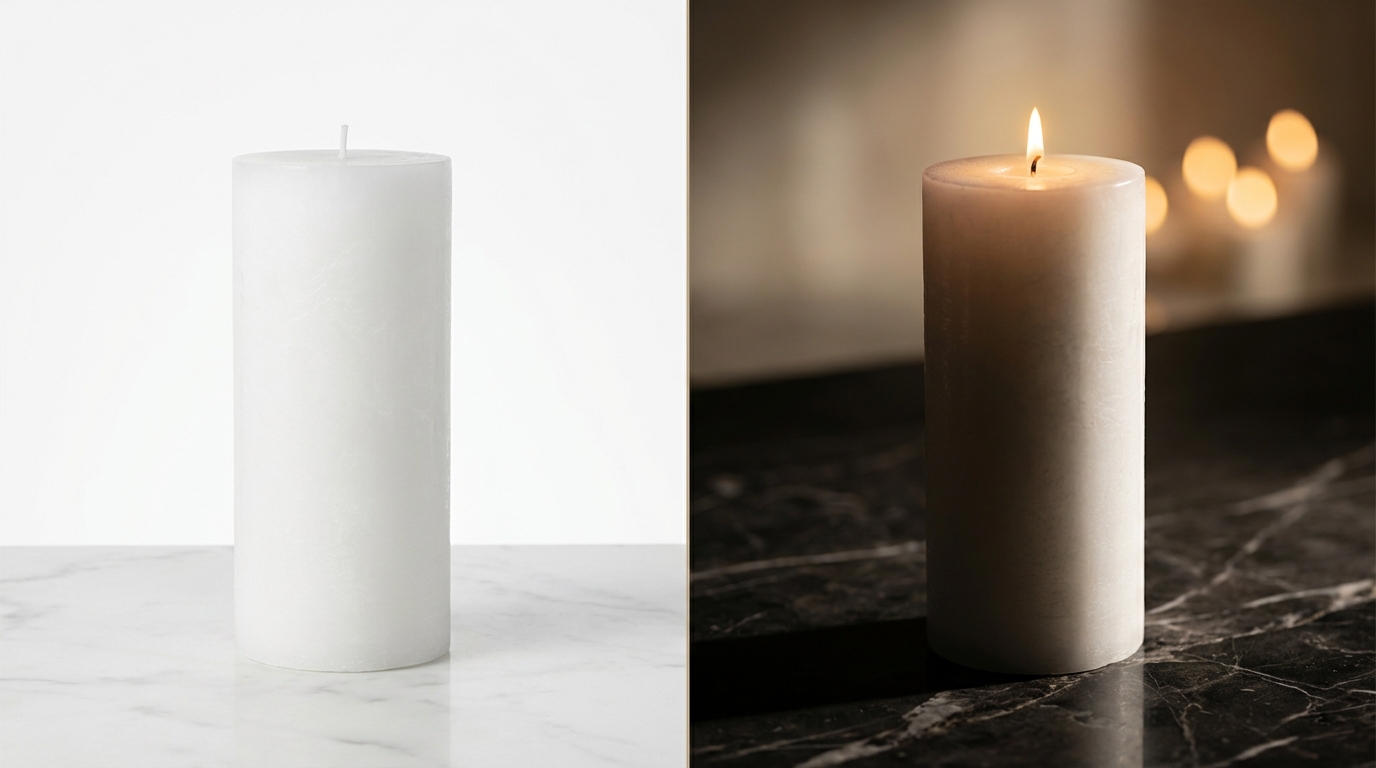
Pro produces images with stronger composition, more controlled light-to-shadow transitions, and higher overall finish. For portfolio work, hero images, commercial product photography, and artistic compositions where the visual quality itself carries weight, Pro consistently delivers results that NB2 does not match.
The thinking mode is particularly valuable for complex scenes — a product photo requiring specific light direction, a portrait with controlled depth of field, or any composition where multiple elements need to work together harmoniously. Pro reasons about these relationships before generating rather than inferring them from pattern recognition alone.
Cross-dimensional style fusion — placing anime characters in realistic environments, blending pencil-sketch figures with photographic backgrounds, mixing clay-style subjects with 2D illustration — holds together more convincingly in Pro. Where NB2’s edge transitions between styles look artificially sharp, Pro’s thinking stage reasons through how the elements should interact, and the result reads as intentional rather than assembled.
The cost trade-off: On Banana AI, Pro costs 10 credits at 1K/2K and 20 credits at 4K — compared to NB2’s 7 credits at 1K/2K and 14 credits at 4K. An Amazon seller who generates 50 product images per month at 4K pays 1,000 credits with Pro vs. 700 credits with NB2. Over a year, that gap is 4,800 credits — equivalent to 4.3 months of the Pro plan at no additional charge. For images where you need quality, that cost is justified. For volume work, it is not.
When to use Pro: Reserve it for the outputs that matter most. Hero images for a product launch. Portfolio images where quality reflects directly on your brand. Artistic compositions where aesthetic excellence justifies the higher cost per generation. Any scene involving style fusion or complex multi-element compositions.
Cost Breakdown: What Different Usage Volumes Actually Cost
On the Pro Plan ($9.90/month, 500 credits)
| Model | Resolution | Credits/Image | Images per Month | Cost per Image |
|---|---|---|---|---|
| Nano Banana | 1K | 5 | 100 | ~$0.10 |
| Nano Banana 2 | 1K/2K | 7 | 71 | ~$0.14 |
| Nano Banana 2 | 4K | 14 | 35 | ~$0.28 |
| Nano Banana Pro | 1K/2K | 10 | 50 | ~$0.20 |
| Nano Banana Pro | 4K | 20 | 25 | ~$0.40 |
NB2 at 1K/2K costs the same as 1K — making 2K the sweet spot for most blog and social media work. You get meaningfully better resolution at no extra cost compared to the 1K tier.
On the Premium Plan ($29.90/month, 2,000 credits)
| Model | Resolution | Cost per Image |
|---|---|---|
| Nano Banana | 1K | ~$0.07 |
| Nano Banana 2 | 1K/2K | ~$0.10 |
| Nano Banana 2 | 4K | ~$0.21 |
| Nano Banana Pro | 1K/2K | ~$0.15 |
| Nano Banana Pro | 4K | ~$0.30 |
Annual Plans for High-Volume Users
| Plan | Price | Credits | NB2 Images at 4K | Pro Images at 4K |
|---|---|---|---|---|
| Pro Yearly | $99.90/year | 6,000 | 428 | 300 |
| Premium Yearly | $299.70/year | 18,000 | 1,285 | 900 |
For high-volume workflows — content teams generating multiple images per day, e-commerce sellers listing hundreds of SKUs — the yearly Premium plan brings NB2 4K cost to approximately $0.23 per image.
Recommendation Matrix: Which Model for Which Job
Use the original Nano Banana when:
- You are exploring concepts before committing to final generation
- Speed is the primary constraint (2-5 seconds vs. 4-6 seconds for NB2)
- You need the lowest possible cost per image and 1K resolution is sufficient
- You are testing prompts and want to iterate through variations quickly
Use Nano Banana 2 when:
- You need ultra-wide or ultra-tall compositions (8:1, 1:8, 4:1, 1:4) — this is NB2-only
- You are generating marketing materials at volume (blog posts, social media, banner ads)
- Accurate multilingual text rendering matters (global posters, multilingual signage)
- You need 4K output but want to maximize the number of images your credit budget covers
- The Image Search capability improves accuracy for real-world location references
- You need character consistency across multiple subjects in a scene
Use Nano Banana Pro when:
- Aesthetic quality is the primary requirement — portfolio work, hero images, commercial output
- The scene involves style fusion (mixing 2D, 3D, photography, sketch in one image)
- You need the thinking mode’s composition analysis for complex multi-element scenes
- The final image will be used in contexts where visual excellence reflects directly on your brand
- You are generating final versions after drafting with NB2 or the original Nano Banana
A practical two-model workflow: Many professional users run NB2 for drafting and volume work, then switch to Pro for the final images that matter most. Banana AI supports model switching within a single chat session — start with NB2 for concept development, refine the direction through conversation, then switch to Pro for the final high-quality output. This approach keeps credit costs manageable without sacrificing quality on the images that need it.
Try All Three Models on Banana AI
The fastest way to understand these trade-offs is to run your own use cases through each model. Banana AI gives you access to all three Nano Banana models in a single chat interface — switch between them in the same session, compare outputs side by side, and see what actually works for your workflow. You can start for free without a credit card.
For more on how the models compare in specific quality scenarios, see our Nano Banana 2 quality benchmark. For a full breakdown of credit costs across plans and use cases, see the NB2 pricing and cost guide.
Try all three models on Banana AI — start free, no credit card required